
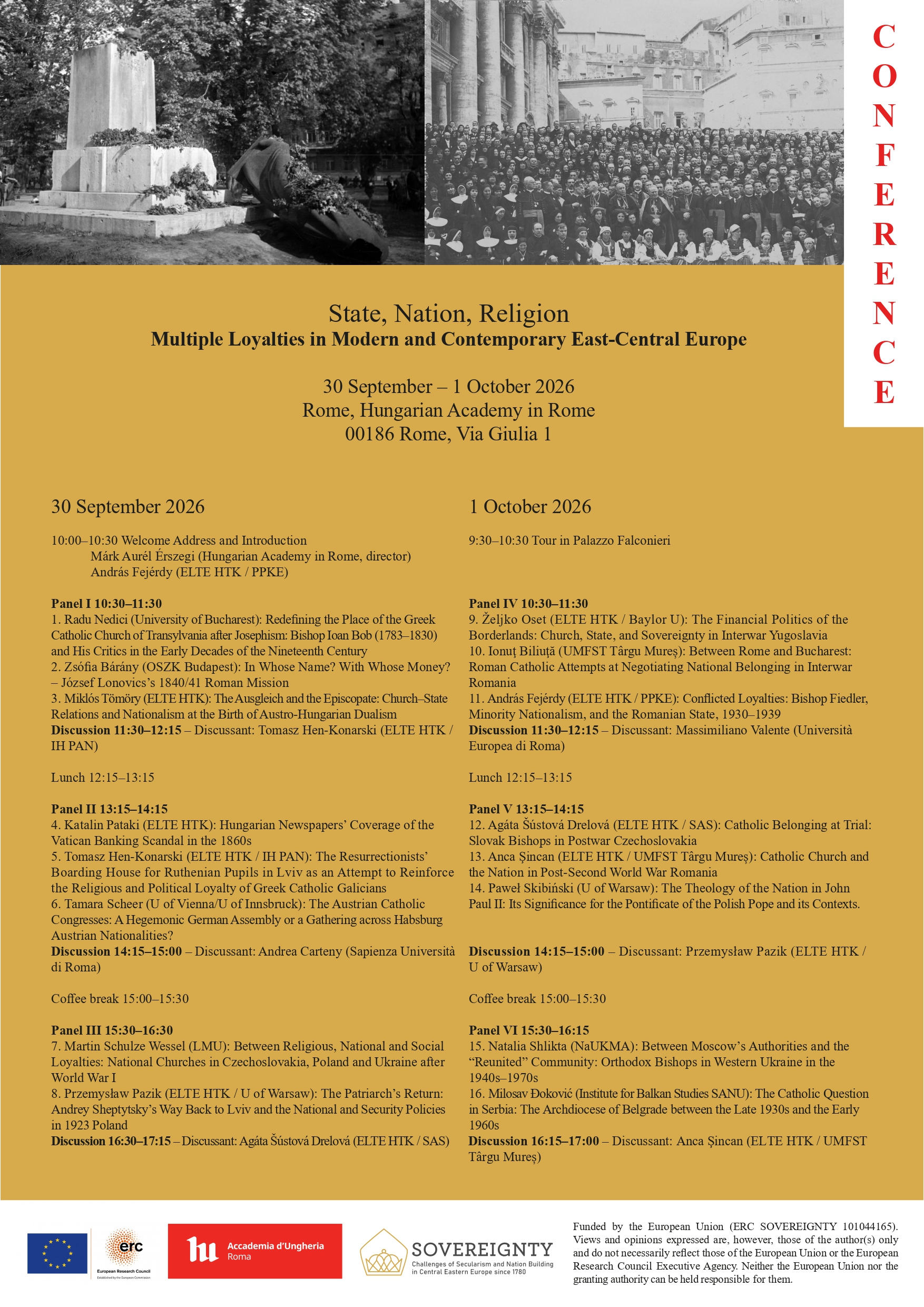
On September 30 and October 1, 2026 the “Sovereignty” ERC research group will organize the conference “State, Nation, Religion. Multiple Loyalties in Modern and Contemporary East-Central Europe” at the Hungarian Academy in Rome. This conference examines the problem of conflicted and negotiated loyalties within the Catholic Church from the nineteenth to the twentieth century, focusing on the interaction between ecclesiastical, national and state allegiances. The event is realized in partnership with Collegium Hungaricum Rome/Accademia d’Ungheria in Roma.
PROGRAM
30 September – 1 October 2026
Rome, Hungarian Academy in Rome
00186 Rome, Via Giulia 1.
30 September 2026
10:00–10:30 Welcome Address and Introduction
Márk Aurél Érszegi (Hungarian Academy in Rome, director)
András Fejérdy (ELTE HTK / PPKE)
Panel I 10:30–11:30
1. Radu Nedici (University of Bucharest): Redefining the Place of the Greek Catholic Church of Transylvania after Josephism: Bishop Ioan Bob (1783–1830) and His Critics in the Early Decades of the Nineteenth Century
2. Zsófia Bárány (OSZK Budapest): In Whose Name? With Whose Money? ‒ József Lonovics’s 1840/41 Roman Mission
3. Miklós Tömöry (ELTE HTK): The Ausgleich and the Episcopate: Church-State Relations and Nationalism at the Birth of Austro-Hungarian Dualism
Discussion 11:30–12:15 – Discussant: Tomasz Hen-Konarski (ELTE HTK / IH PAN)
Lunch 12:15–13:15
Panel II 13:15–14:15
4. Katalin Pataki (ELTE HTK): Hungarian Newspapers’ Coverage of Vatican Banking Scandal in the 1860s
5. Tomasz Hen-Konarski (ELTE HTK / IH PAN): Resurrectionists’ Boarding House for Ruthenian Pupils in Lviv as an Attempt to Reinforce the Religious and Political Loyalty of Greek Catholic Galicians
6. Tamara Scheer (U of Vienna/U of Innsbruck): The Austrian Catholic Congresses: A Hegemonic German Assembly or a Gathering across Habsburg Austrian Nationalities?
Discussion 14:15–15:00 – Discussant: Andrea Carteny (Sapienza Università di Roma)
Coffee break 15:00–15:30
Panel III 15:30–16:30
7. Martin Schulze Wessel (LMU): Between Religious, National and Social loyalties: National Churches in Czechoslovakia, Poland and Ukraine after World War I.
8. Przemysław Pazik (ELTE HTK / U of Warsaw): The Patriarch’s Return: Andry Sheptytsky’s Way Back to Lviv and the National and Security Policies in 1923 Poland
Discussion 16:30–17:15 – Discussant: Agáta Šústová Drelová (ELTE HTK / SAS)
DAY 2 (1 Oct)
Tour in Palazzo Falconieri 9:30–10:30
Panel IV 10:30–11:30
9. Željko Oset (ELTE HTK / Baylor U): The Financial Politics of the Borderlands: Church, State, and Sovereignty in Interwar Yugoslavia
10. Ionuţ Biliuţă (UMFST Targu Mures): Between Rome and Bucharest: Roman Catholic Attempts at Negotiating National Belonging in Interwar Romania
11. András Fejérdy (ELTE HTK / PPKE): Conflicted Loyalties: Bishop Fiedler, Minority Nationalism, and the Romanian State 1930–1939
Discussion 11:30–12:15 – Discussant: Massimiliano Valente (Università Europea di Roma)
Lunch 12:15–13:15
Panel V 13:15–14:15
12. Agáta Šústová Drelová (ELTE HTK / SAS): Catholic Belonging at Trial: Slovak Bishops in Postwar Czechoslovakia
13. Anca Şincan (ELTE HTK / UMFST Tîrgu Mureş): Catholic Church and the Nation in post Second World War Romania
14. Pawel Skibiński (U of Warsaw): The Theology of the Nation in John Paul II. Its Significance for the Pontificate of the Polish Pope and its Contexts.
Discussion 14:15–15:00 – Discussant: Przemysław Pazik (ELTE HTK / U of Warsaw)
Coffee break 15:00–15:30
Panel VI 15:30–16:15
15. Natalia Shlikta (NaUKMA): Between Moscow’s Authorities and the “Reunited” Community: Orthodox Bishops in Western Ukraine in the 1940s–1970s
16. Milosav Đoković (Institute for Balkan studies SANU): La questione cattolica in Serbia – L’arcidiocesi di Belgrado dal 1924 al 1964
Discussion 16:15–17:00 – Anca Şincan (ELTE HTK / UMFST Tîrgu Mureş)
(program updated on September 25.)
Funded by the European Union (ERC SOVEREIGNTY 101044165). Views and opinions expressed are, however, those of the author(s) only and do not necessarily reflect those of the European Union or the European Research Council Executive Agency. Neither the European Union nor the granting authority can be held responsible for them